
Fairfield County Driveway Zoning & Permit Cheat Sheet
Introduction: Why "Just Paving It" Can Cost You Thousands
Did you know that if you widen your driveway by just a few feet in towns like Greenwich or New Canaan, you have to prove zero increase in stormwater runoff? This frequently compels the house owners to install artificial drainage systems, which cost thousands of dollars more than the driveway.
This is a surprise for many Fairfield County homeowners, as driveway projects feel simple. However, they aren’t.
Fairfield County has some of the strictest land use and zoning laws and regulations in Connecticut. This is true especially when it’s about:
- Impervious surface coverage
- Stormwater runoff and drainage
- Historic and scenic road protections
- Coastal Area Management (CAM) compliance
- Public Right-of-Way and apron permits
Any paving project that skips one step can result in:
- Stop-work orders
- Forced removal of new paving
- Expensive redesigns after the fact
Therefore, to spread awareness, we have created this guide. This guide can help homeowners, designers, and Realtors learn coverage limits, what’s allowed, setbacks, and town rules before construction begins.
Disclaimer: “Regulations change frequently. This guide is for informational purposes. Always consult with G&L Paving and your local town hall for the most current codes.”
Quick Reference: Key Driveway Regulations by Town
G & L Paving and Masonry offers a wide range of paving and masonry services for the citizens of Connecticut. Let’s explore them one by one:
| Town | The “Big” Rule | What to Be Careful About |
|---|---|---|
| Greenwich | Impervious surface and green-area requirements are enforced through zoning + stormwater inspection, not a single universal “driveway cap.” | Pools, patios, and driveways are evaluated together during site and stormwater review; outcomes are zone- and site-specific. |
| New Canaan | Added impervious surface must demonstrate zero increase in stormwater runoff per the Town’s Drainage Certification Policy. | Even small driveway expansions can require engineered mitigation (e.g., infiltration, detention, permeable systems). |
| Darien | Stormwater management review applies when impervious area increases under MS4 standards. | Rules are different for private roads and town roads. |
| Westport | Coverage limits apply; properties in coastal zones are subject to Coastal Area Management (CAM) oversight. | Gravel may be treated as impervious depending on installation and location, not only asphalt. |
| Fairfield | Work within the public right-of-way (ROW) — including driveways — is controlled. | You can’t change the driveway apron without town approval. You require a Right of Way permit for that. |
| Wilton / Ridgefield | Some roads and areas have environmental protection rules. | Stone walls or large trees may need approval before removal on defined scenic roads. |
| Stamford | Curb cuts and driveway entrances are regulated by the Engineering Department. | You can widen your driveway, but the street entrance often cannot be changed without approval. |

The "Strict Coverage" Towns (Greenwich, New Canaan, Darien)
An impervious surface is a hard, built surface that cannot absorb rainwater into the soil. This causes stormwater runoff, flooding, and erosion. These surfaces are often made using asphalt, concrete, compacted gravel, etc. Some common examples include:
- Parking lots
- Driveways
- Sidewalks
- Buildings
- Roofs
- Patios
Greenwich, Darien, and New Canaan are known for strict driveway rules. They mainly focus on safety, drainage, and the town’s standards. Moreover, you should expect detailed plans, inspections, potential reviews for approvals, and penalties (if rules are not followed).
In high-end towns, large estate owners often max out their allowed coverage by adding pools, guest houses, tennis courts, walkways, or patios. When they want to widen their driveway, the town says, “You’re already maxed out”, after calculating their coverage.
The only practical workaround is permeable paving systems. They are the only zoning-compliant option as they aren’t like traditional impervious surfaces.
The "Coastal Zone" Towns (Westport, Norwalk, Fairfield)
In case your residence is close to Long Island Sound, it can be covered by the Connecticut Coastal Area Act (CCMA). CCMA in Westport, Fairfield, and Norwalk is a state-level program designed to balance the growth, preservation, restoration, and use of coastal land and water resources. CAM focuses on:
- Preventing water runoff
- Protecting coastal waters
- Decreasing erosion
- Protecting resources
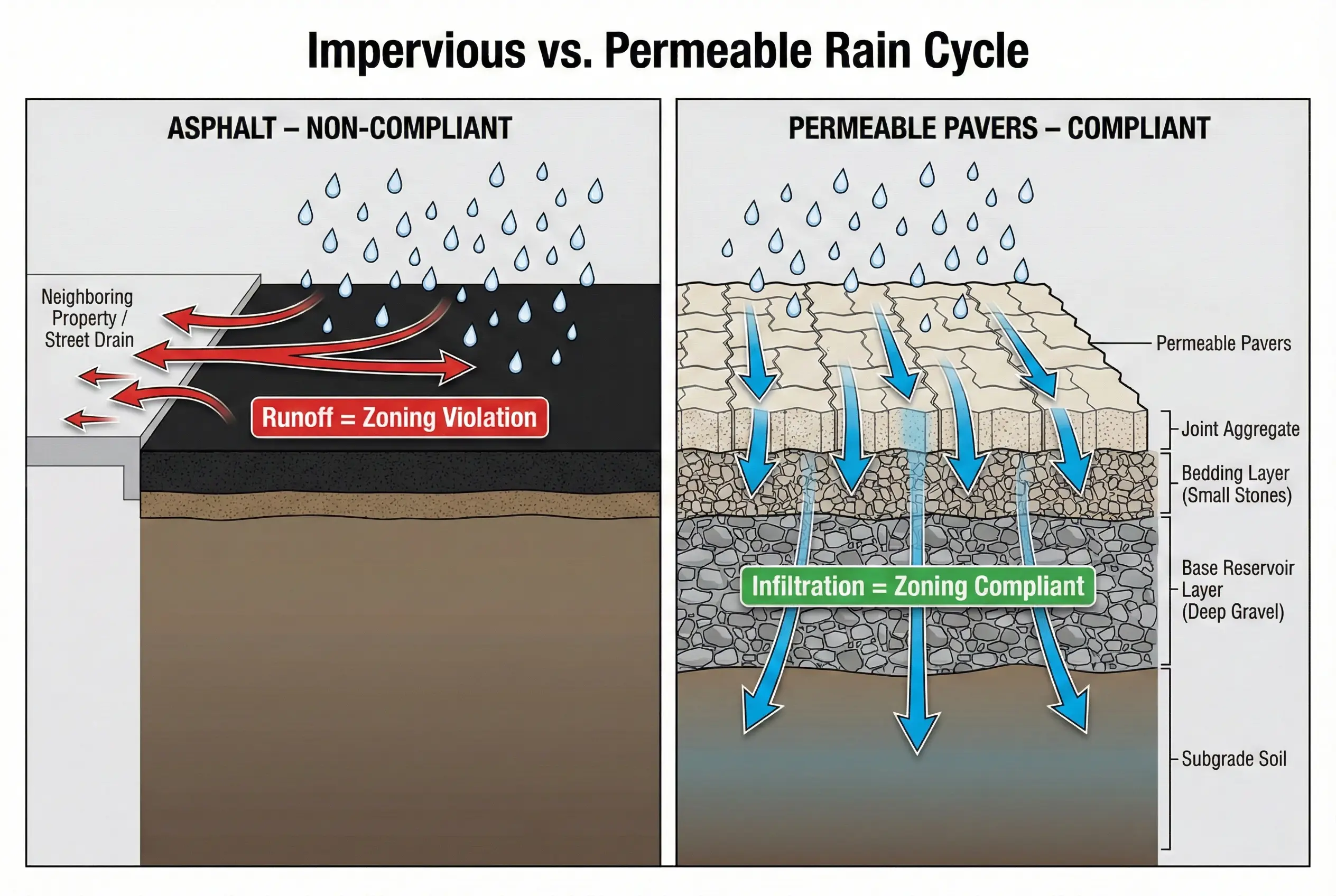
Traditional asphalt directs rainwater directly into streets, coastal waterways, and storm drains. This causes runoff pollution, which means you cannot get rainwater running down the street. In CAM zones, unmanaged runoff can halt your permit approval.
You can adopt low-impact development (LID) in order to avoid runoffs of rainwater and other hard surfaces like asphalt. You can do this by adding:
- Engineered stone bases
- Controlled drainage paths
- Systems that slow and absorb water onsite
When designed perfectly, these systems meet the regulations of CAM without changing the appearance of your driveways.
The "Coastal Zone" Towns (Westport, Norwalk, Fairfield)
In case your residence is close to Long Island Sound, it can be covered by the Connecticut Coastal Area Act (CCMA). CCMA in Westport, Fairfield, and Norwalk is a state-level program designed to balance the growth, preservation, restoration, and use of coastal land and water resources. CAM focuses on:
- Preventing water runoff
- Protecting coastal waters
- Decreasing erosion
- Protecting resources
Traditional asphalt directs rainwater directly into streets, coastal waterways, and storm drains. This causes runoff pollution, which means you cannot get rainwater running down the street. In CAM zones, unmanaged runoff can halt your permit approval.
You can adopt low-impact development (LID) in order to avoid runoffs of rainwater and other hard surfaces like asphalt. You can do this by adding:
- Engineered stone bases
- Controlled drainage paths
- Systems that slow and absorb water onsite
When designed perfectly, these systems meet the regulations of CAM without changing the appearance of your driveways.
The "Scenic & Watershed" Towns (Wilton, Ridgefield, Easton, Weston)
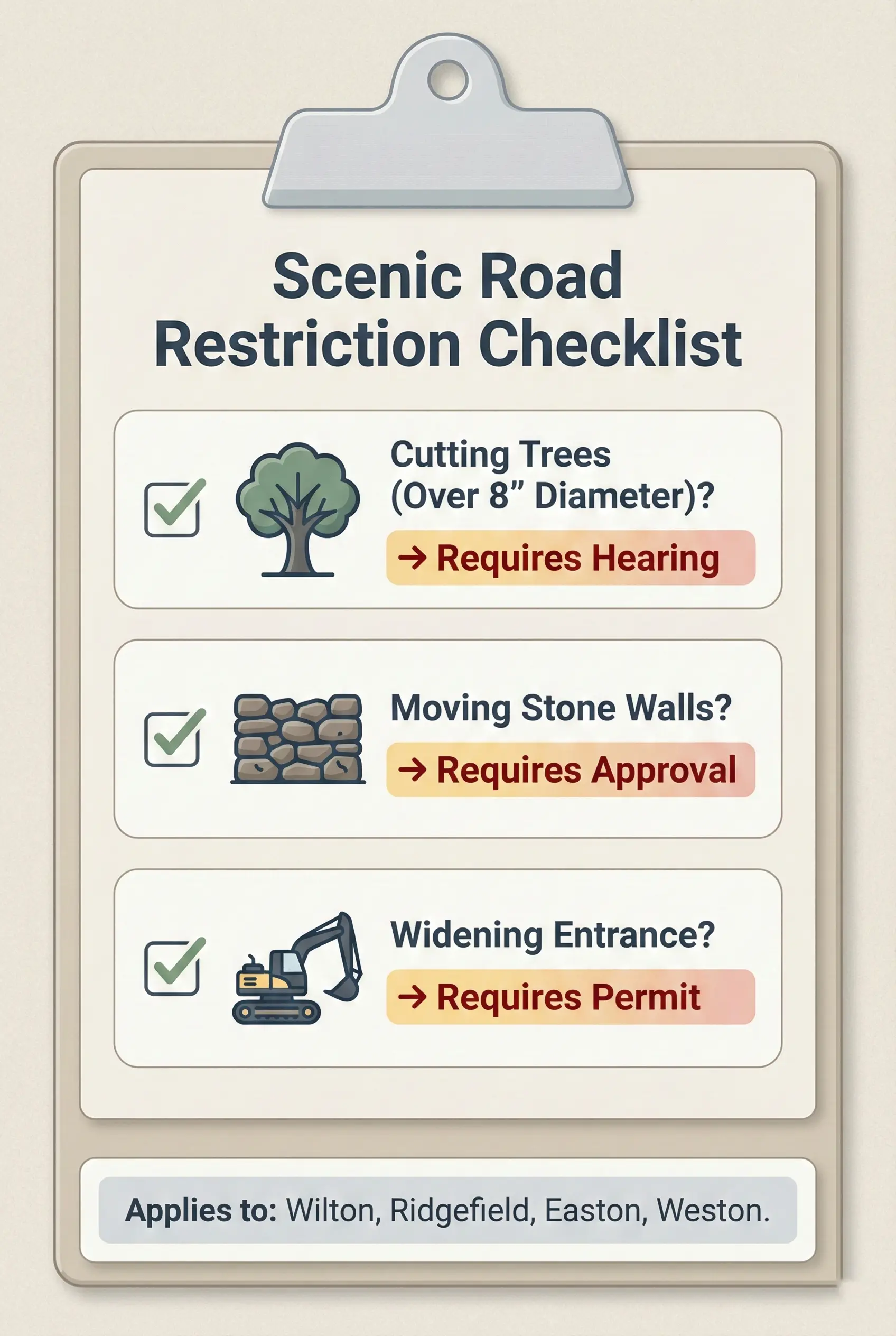
Most of the roads in Wilton, Easton, Weston, and Ridgefield are legally declared as Scenic Roads. This is to protect their historical aesthetics from any type of improvement or development projects. This means:
- Tree removal may require a hearing
- Widening an entrance can trigger public review
- Stone walls cannot be removed or relocated without approval
Anyone who wants to cut down trees or remove stone walls to widen their driveways may require approval or a hearing.
These towns do not rely on sewers but on septic systems (on-site wastewater disposal systems). It implies that you cannot overlay a leaching field or modify the drainage patterns in the surroundings of the septic areas. If you do so, this can cause failed inspections or compulsory removal of the paving.
The "Urban & Northern" Hubs (Stamford, Danbury, Trumbull)
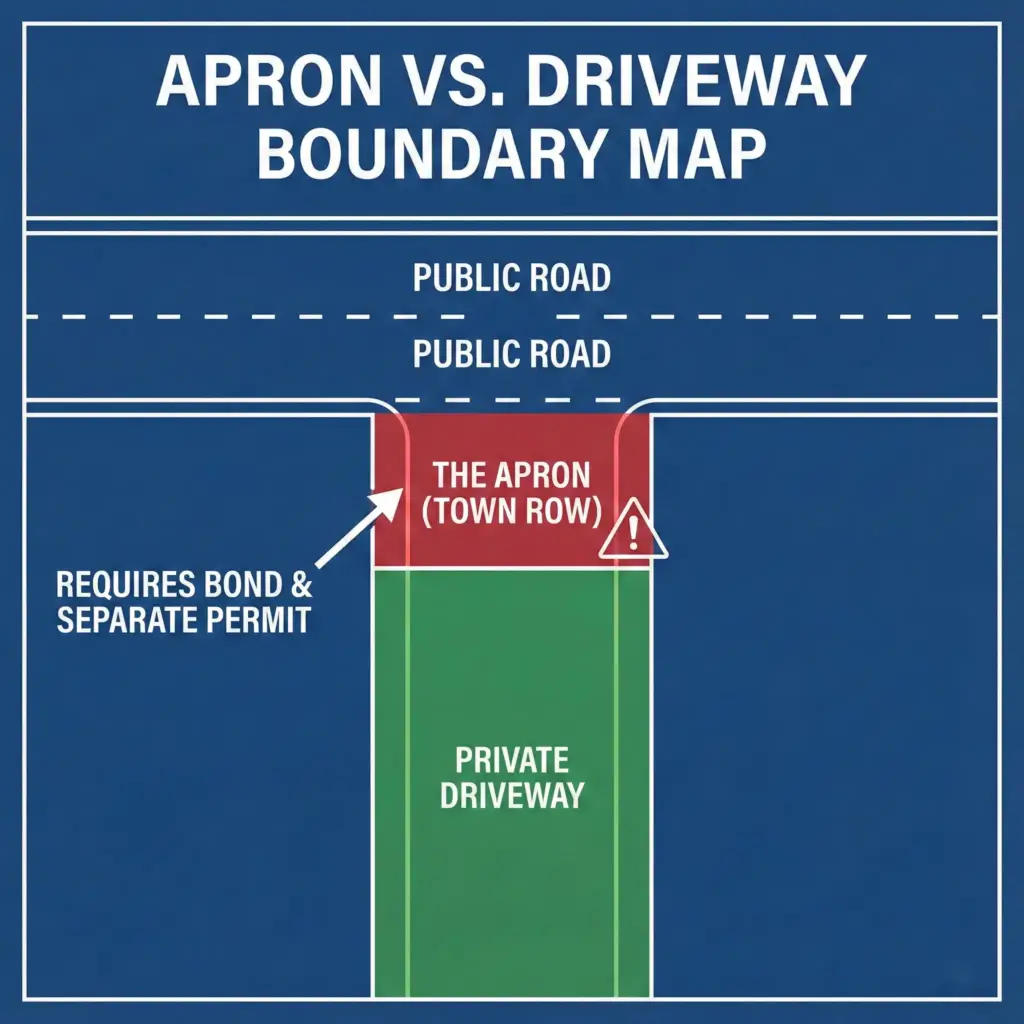
In towns like Stamford, Trumbull, and Danbury, most homeowners don’t realize the apron. This means they don’t know that they don’t own the first 10-15 feet of their driveways. An apron is the area of the driveway that links the private driveways to the public street. This section is part of the public Right-of-Way.
The apron usually needs a separate permit. Moreover, it may require bonds or inspections, and the curb cuts are tightly controlled. Construction and maintenance of this section are generally governed by the town’s municipal regulations.
Moving forward, this is one of the most common reasons projects get halted mid-construction. The homeowners are generally unaware of the fact that they don’t own the Apron.
Decoding the Jargon: What Do These Terms Actually Mean?
What is "Impervious Surface Coverage"?
Impervious surface is any surface that cannot absorb rainwater and is usually made up of asphalt, concrete, or compacted gravel.
Impervious surface coverage (ISC) is the percentage of a property covered by the non-porous, hard materials that prevent rainfall or snowmelt from soaking into the soil. This increases the chances of flooding, pollution, or erosion. ISC is generally controlled by town municipalities to combat water quality, stormwater, and habitat loss.
Every town caps how much of your lot can be covered.
Understanding "Zero Increase in Runoff"
Zero increase in runoff means the rainfall of your new driveway must be managed on your property and should not be sent toward the street or any neighbor. This is an engineering and regulatory requirement in land development. Moreover, this may require engineered drainage solutions.
The "Apron" vs. The "Driveway": Who Owns What?
Apron:
Apron, also known as the driveway approach or driveway skirt, is specifically the area between the driveway and the public street. It is generally built with stricter municipal codes for drainage and durability. It is owned by the local municipality.
Driveway:
The driveway is the section or path from your garage or house to the street. It provides vehicle entry to your home and is usually made up of materials like concrete, asphalt, or pavers. It also follows different standards from the apron and is owned by the property owner.
The Zoning Solution: Permeable Pavers & Drainage
How Permeable Systems Work [Infographic]
Permeable paving systems act like a natural water cycle by letting rainwater absorb into the soil. It permits water to:
- Pass through the joints
- Filter into a specially designed stone base
- Slowly absorbed into the ground
This turns your driveway into a functional drainage system, not just a surface. We at G & L Paving and Masonry offer permeable paving systems installation in Fairfield County. You can hire our professionals to install permeable systems to follow zoning laws and regulations.
Calculating the Cost-Benefit: Pavers vs. Detention Tanks
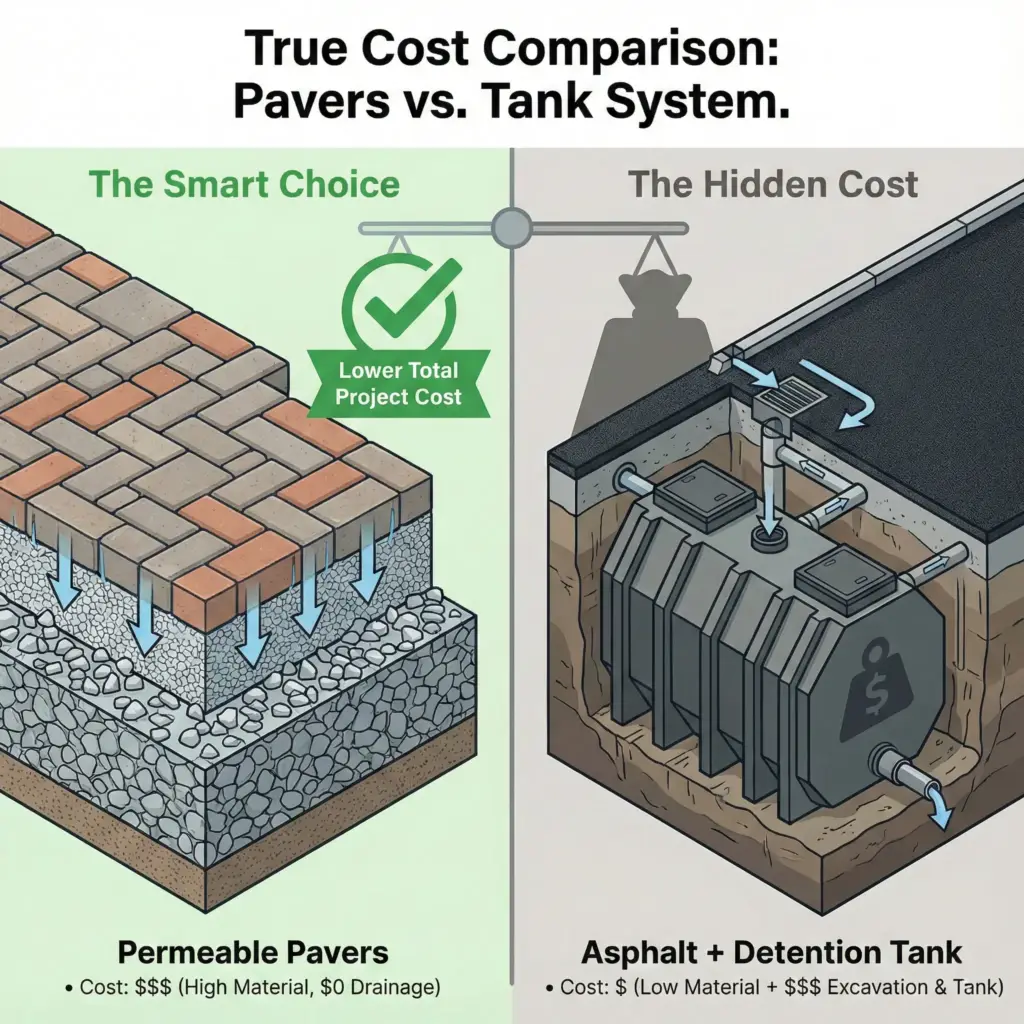
When a town’s municipal officials tell you your driveway change can’t increase stormwater runoff, you usually have two practical options:
- Use permeable pavers (so water soaks in)
- Keep a normal driveway surface, but add an underground drainage system (detention/infiltration tank, drywell, or similar)
While permeable pavers cost more than basic asphalt upfront, they often remove the need for:
- Underground detention tanks
- Concrete vaults
- Complex drainage retrofits
Detention tanks are usually hidden underground and can handle larger runoff volumes. However, they require excavation, engineering plans, and long-term maintenance. This can push total costs well beyond the price of the driveway itself.
In many Fairfield County projects, permeable pavers cost less overall than asphalt plus engineered stormwater systems.
Historic Considerations: Protecting the "Connecticut Look"
Rules for Altering Stone Walls on Scenic Roads
In many Fairfield County towns like Wilton, Easton, Weston, and Ridgefield, stone walls along historic or scenic roads are protected. If a wall must be moved for a driveway, it shouldn’t be removed or replaced with new materials. Instead:
- Rebuild the wall using the same stones
- Its original style and height must be preserved
- Approval from planning and zoning departments is often required before work starts
If you want high-end, municipal-compliant masonry and stone wall restoration services, count on G & L Paving and Masonry. We employ the best materials, tools, and techniques to build paving or masonry structures. Contact us today to learn more about our masonry services.
Why "Oil and Stone" is Preferred in Historic Districts
In historic districts like Southport or Silvermine, blacktop may be considered too modern. Oil & Stone, also known as tar-and-chip or chip seal, is preferred in Fairfield County towns. This is because it:
- Preserves historic appearance
- Meets many district guidelines
- Blends with older homes and landscapes
- Has a natural, softer, and rustic aesthetic appeal
Frequently Asked Questions (FAQ)
Do I need a permit to resurface my existing driveway?
Usually, no, if you aren’t changing the size. But always check with your town’s regulations.
Can I widen my driveway entrance on a state road?
It is very difficult. This typically requires Connecticut DOT approval, not just town approval.
Does a gravel driveway count as "Impervious Surface"?
Yes. In towns like Greenwich and Westport, compacted gravel is legally treated as impervious for zoning purposes.
Need Help Navigating the Red Tape?
Don’t guess and get fined. Local driveway and masonry rules can be confusing. Small changes can result in unexpected permits, added costs, or reviews.
At G & L Paving and Masonry, we handle zoning reviews, permit coordination, and installation that passes inspection the first time, and drainage-compliant design. We know Fairfield County regulations, allowing us to save you time and money. Our professional team plans projects the right way from the start and avoids costly surprises in the future.